Termite activity in coastal Florida accelerates significantly due to year-round relative humidity exceeding 70% and sandy soil profiles that facilitate subterranean movement. According to research from the University…
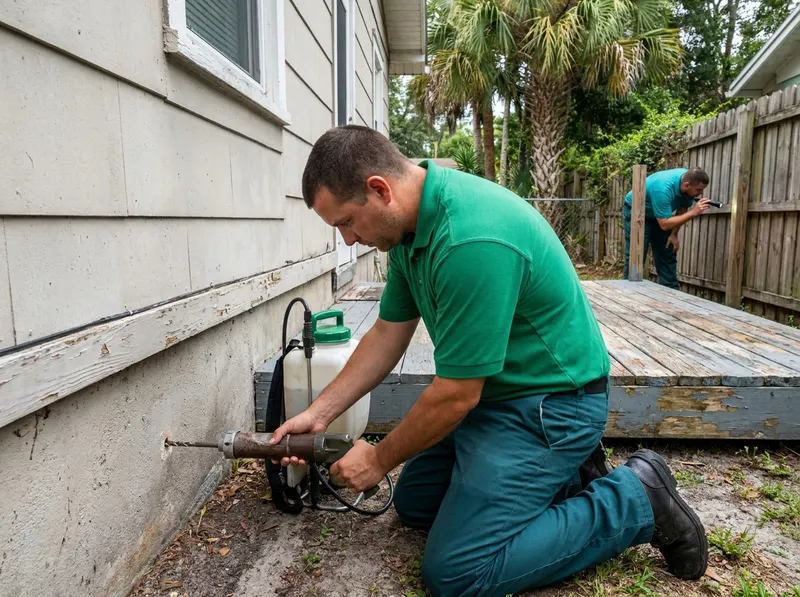
Termite activity in coastal Florida accelerates significantly due to year-round relative humidity exceeding 70% and sandy soil profiles that facilitate subterranean movement. According to research from the University of Florida Entomology and Nematology Department, subterranean species establish massive colonies beneath ground level, accessing sill plates and wall studs via sheltered mud tubes. Conversely, drywood termites enter structures directly through attic vents, fascia boards, and window framing, requiring no soil contact. In historic Tampa neighborhoods such as Seminole Heights, Tampa Heights, and Ybor City, early 20th-century heart pine framing demands targeted interior wood penetrations, while slab-on-grade developments across New Tampa, Carrollwood, and Westchase primarily experience subterranean perimeter pressure.
Effective mitigation relies on establishing continuous defensive boundaries. Non-repellent chemical treatments utilize active ingredients registered under the Environmental Protection Agency, such as fipronil or imidacloprid, allowing foraging insects to unwittingly transfer the formula back to the reproductive caste. The Florida Department of Agriculture and Consumer Services regulates structural pesticide applications, establishing strict standards for trenching and rodding depths around load-bearing masonry. For subterranean colonies, soil barrier trenching applies 4 gallons of dilution per 10 linear feet per foot of depth alongside foundations. In contrast, drywood infestations confined to isolated framing timbers benefit from localized pressure injections of termiticidal foam or borate mineral salts recognized by the USDA Forest Service for long-term cellulose preservation.
Property owners evaluating remediation options face a fundamental trade-off between localized spot treatments and full-perimeter barrier installations. Spot applications isolate confirmed activity within a specific 5-to-10-foot wood member, minimizing treatment footprint and lowering upfront costs, but they leave remaining structural timbers vulnerable to undetected satellite colonies. Complete perimeter barrier treatments require extensive continuous exterior trenching and foundation drilling, delivering complete perimeter exclusion at a higher initial investment. Guidelines from the U.S. Department of Housing and Urban Development specify strict subterranean barrier requirements for residential lending transfers, emphasizing continuous structural shields over temporary patches. Protocols outlined by the National Pest Management Association confirm that proactive barrier replenishment every 5 to 7 years prevents catastrophic structural failures. For homeowners near open water in Davis Islands, Ballast Point, Palma Ceia, and Hyde Park, treatments adhere strictly to Florida Department of Environmental Protection rules to eliminate runoff risks into Hillsborough Bay.
1. Technicians conduct a multi-point inspection examining interior baseboards, crawlspaces, subflooring, and attic trusses under guidelines from the International Association of Certified Home Inspectors.
2. Species identification confirms whether frass pellets indicate drywood activity or mud tubes indicate subterranean tunneling.
3. The treatment plan establishes continuous liquid termiticide barriers along foundation perimeters or delivers direct foam voids into infested wood framing.
4. Interior living quarters receive low-toxicity perimeter treatments aligned with safety baselines established by the National Institute for Occupational Safety and Health.
5. Post-treatment verification checks moisture levels and material absorption using diagnostic instruments certified by the National Institute of Standards and Technology.
Every job gets a firm, written price after a free on-site visit.
For standards, safe disposal, and service guidance on PEST CONTROL SEVICE in Tampa, FL, useful references include U.S. EPA, ENERGY STAR, U.S. Dept. of Energy, Consumer.gov, U.S. Census Bureau, and Google Maps. General consumer and small-business resources are available from USA.gov, Better Business Bureau, FTC Consumer Advice, U.S. Small Business Administration, and Ready.gov.
Tell us about your subterranean and drywood termite control job in Tampa and we'll send a clear, written quote, usually the same day.
 DirectCare Pest Solutions